The moment you pick a side in any culture war you lose...
You lose because the only solution is total capitulation to a view you find repugnant or total domination of a person (not the idea of a person, but the person herself) you make your opposition.
You not only lose, you play into the designs* of the technologies prone to structurally embed themselves in our institutions, ideologies, and identities.
You become less yourself and more of what technology wants you to be...
There is a bone-deep assumption in our culture that if you're not against 'x', you're for 'y'. That if you are a 'z', you fall in line with this set of assumptions.
To briefly enflesh this idea: We have lost the imagination, wisdom, and praxis that would allow someone to be neither pro-life nor pro-choice.
In 2026, to reject both sides is unfathomable.
Why is this the case?
Why on issues like abortion, sexuality, immigration, policing, war, gun control, justice, labor, and religion do we so often neglect nuance to see solutions and sides as monolithic?
Name it polarization. Name it enrage-ification. Name it the constant pull to extremities that online attention spans require or just call it human nature. Whatever it manifests as, its fruits are in full blossom decades into the machine-powered revolution.
Looking more closely at our recent history for answers, the Entertainment and subsequent Digital Age might wear different clothing, but they speak the same language...
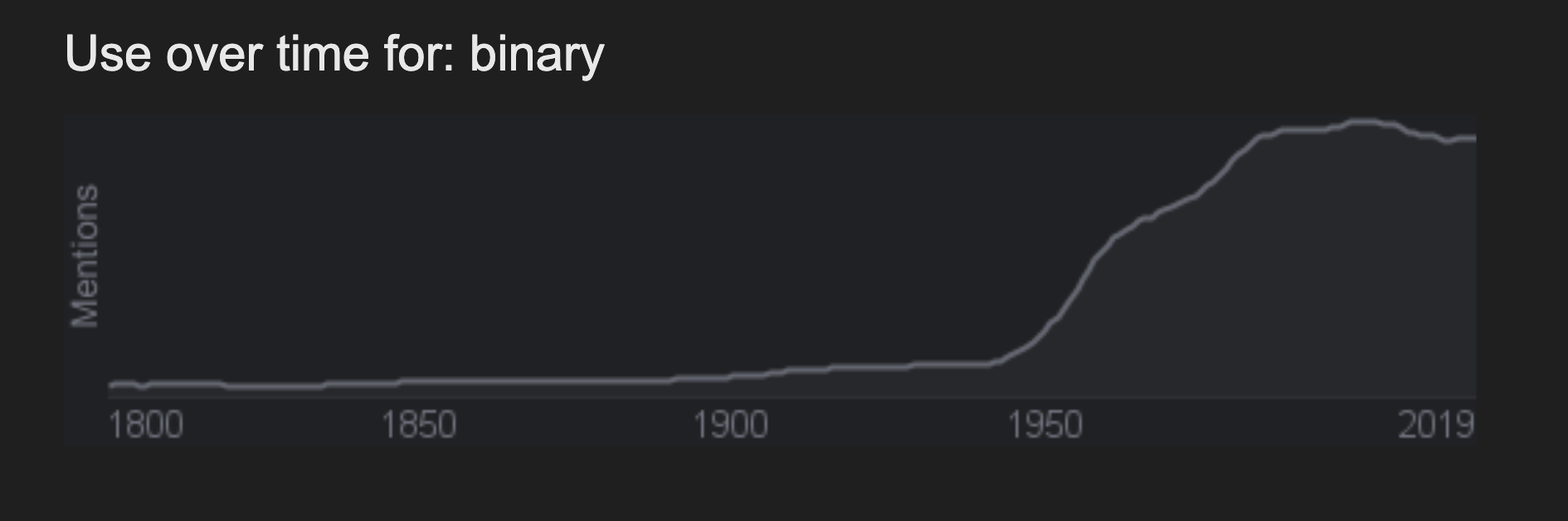
Binary | adj. or n.
~ relating to, composed of, or involving two things,
~ (in technical terminology) a numbering system using only 0 and 1 to represent data, instructions, and physical states (on/off, high/low voltage) in digital electronics and computing
Binaries, or dualities as they have been referred to in philosophical dialogue, have always existed. Light and dark. Good and not good.
Religions were born, emperors rose to power, and common laborers maintained a sense of place within binary paradigms of existence. Evidence that we're prone to this kind of thinking, but, importantly, not trapped by it, could lead us to think our current crises of community
The language of computing is composed of either a "yes" or a "no". This or that. Win or lose. Bits of data are communicated through electrical pulses to terminals that provide outputs upon which we have come to base our lives.
If this level of mechanically un-nuanced thinking dictates the behavior of the processors that shape our mediums and memory, how much are the conversations we have, reports we hear, and beliefs we hold shaped by a lack of deeper dives underneath the surface of a yes-no binary?
In a culture of performative signaling that aligns parties with the perceived capital-holder's, how blatantly do we neglect the second and third order effects of our oversimplifications upon those who don't wield any conversational power?
Shaped by the need to communicate efficiently and without complex signals, how unaware are we of the land-locked dualism that makes us blind to third ways and hidden coves?
As I said at the start, if you've fallen into a binary, you've already lost.
*Note: these designs aren't those of Meta, Amazon, X, or OpenAI's executive leadership or foundational developers. These players and platforms are shaped by the same subliminal paradigms of technology. They do nothing but feed the already churning engine of technological reproduction...